

Introduction
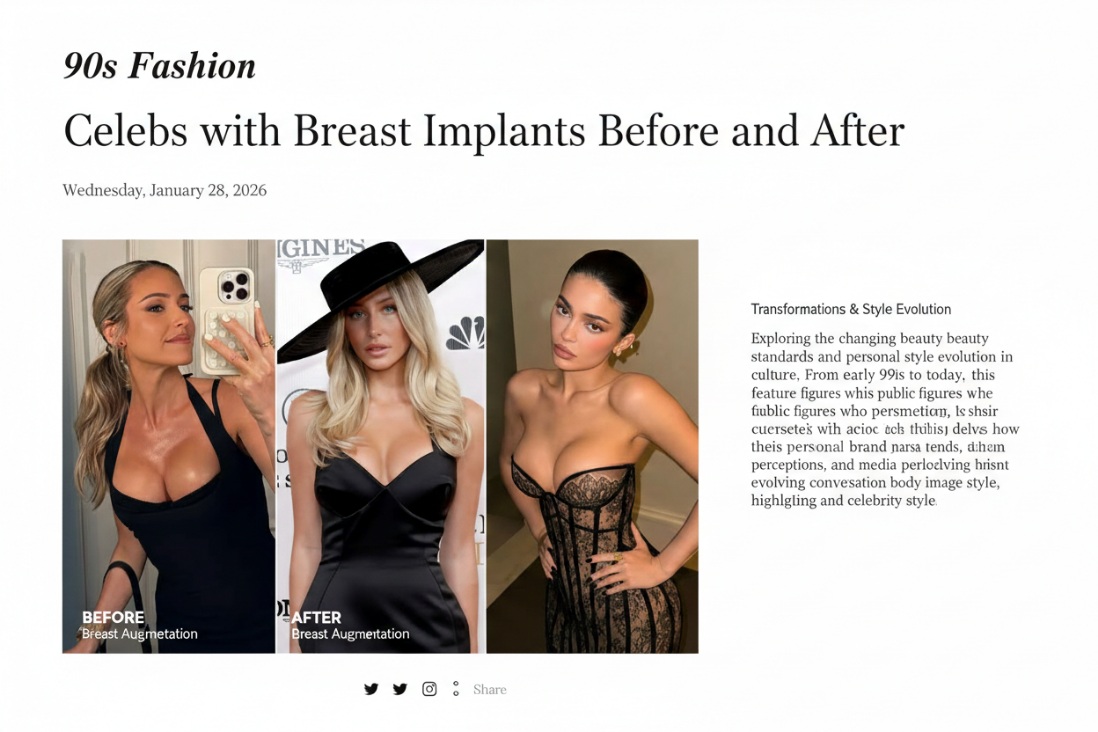
When people search for celebs with breast implants before and after, they’re usually trying to understand how surgery may change appearance, what realistic results look like, and whether photographs show an accurate transformation. In this article I’ll walk you through how to read before-and-after images, explain the common types of breast augmentation, outline typical recovery milestones and risks (without making medical promises), discuss alternatives like fat transfer, and offer practical tips for spotting genuine comparisons. The goal is to give you trustworthy, readable information so you can judge images—and choices—calmly and clearly.
- Introduction
- 1. Why people look at “before and after” photos of celebs
- 2. What the keyword “celebs with breast implants before and after” usually refers to
- 3. Basics of breast augmentation (what the procedures actually involve)
- 4. How real surgery changes look over time: immediate vs final results
- 5. Why photos can mislead: lighting, posture, clothing, and editing
- 6. Common risks and safe practices to watch for (non-medical overview)
- 7. Alternatives to implants and why some celebs choose them
- 8. How to evaluate a before-and-after photo reliably (practical checklist)
- 9. Ethical and privacy considerations when discussing public figures
- 10. Celebrity case studies — how to learn, not gossip
- 11. Realistic expectations: what a before-and-after should tell you
- 12. How to talk to a surgeon (what to ask, non-medical framing)
- 13. Frequently Asked Questions (FAQs)
- 14. Checklist for journalists, bloggers, and content creators
- 15. Visual literacy: what to look for in an honest before-and-after gallery
- 16. Language and tone: how to discuss transformations respectfully
- 17. Final thoughts — balancing curiosity with responsibility
Table of contents
- Why people look at “before and after” photos of celebs
- What the keyword celebs with breast implants before and after usually refers to
- Basics of breast augmentation (implant types, placement, incision)
- How real surgery changes look over time: immediate vs final results
- Why photos can mislead: lighting, posture, clothing, and editing
- Common risks and safe-practices to watch for (non-medical overview)
- Alternatives to implants and why some celebs choose them
- How to evaluate a before-and-after photo reliably (step-by-step checklist)
- Ethical and privacy considerations when discussing public figures
- Celebrity case studies — what to learn, not gossip (how to approach reported examples)
- Frequently asked questions (FAQs)
- Final thoughts and responsible next steps
1. Why people look at “before and after” photos of celebs
Celebrities are high-visibility examples of aesthetic change: their images are widely published, they have teams (stylists, makeup artists, lighting, photographers), and their transformations get public attention. People search “celebs with breast implants before and after” to:
- See realistic aesthetic outcomes of augmentation.
- Compare different implant sizes, shapes, and placements.
- Learn what to expect during recovery and how long results take to settle.
- Understand how other factors—age, body type, lifestyle—affect final appearance.
Understanding why someone looks at these photos helps put the images in context: celebrities’ photos are not clinical documentation and should not be taken as medical proof.
2. What the keyword “celebs with breast implants before and after” usually refers to
Searchers looking for celebs with breast implants before and after typically mean one of the following:
- Side-by-side images published in media showing a celebrity earlier in their career vs. after a reported augmentation.
- Timeline photos that track appearance changes across years.
- Magazine spreads or social posts where a public figure discusses having had implants and shares photos.
- Commentary or “celebrity lookbook” content that compares surgical outcomes.
It’s important to treat such images as illustrative rather than conclusive evidence of surgery. Public figures often undergo many non-surgical aesthetic treatments and changes in weight, makeup, wardrobe, and posing that dramatically alter appearance.
3. Basics of breast augmentation (what the procedures actually involve)
This section gives a straightforward, non-clinical overview so you can read transformations with more understanding. It’s not medical advice—if you’re considering surgery, consult a board-certified professional.
3.1 Implant types
- Saline implants: Filled with sterile salt water. Inserted empty and filled once in place. They allow smaller incisions but can feel less natural in some patients.
- Silicone implants: Pre-filled with silicone gel that often gives a more natural feel and shape. They may require a slightly larger incision because they’re pre-filled.
- Gummy bear / form-stable implants: A type of silicone implant that keeps its shape even if the shell breaks; usually more stable in contour.
- Shape and profile choices: Round vs. teardrop (anatomical); low, moderate, or high profile affects projection.
3.2 Implant placement
- Subglandular (above the muscle): Implant sits under breast tissue but above chest muscle. Can create a more projected look but may show implant edges in leaner patients.
- Submuscular or dual-plane (partly under the muscle): Often used to create a smoother transition at the top of the breast and reduce rippling.
3.3 Incisions (common approaches)
- Inframammary fold: Underneath the breast—very commonly used.
- Periareolar: Around the lower edge of the areola.
- Transaxillary: Through the armpit.
- Transumbilical: Less common; entry through the navel for saline implants.
3.4 Typical result timeline (general, non-prescriptive)
- Immediate post-op: Swelling, high positioning, firm feel.
- 2–6 weeks: Decreasing swelling, tissues begin to settle.
- 3–6 months: More natural shape emerges; implants find their final position.
- 6–12 months: Final aesthetic outcome for many people.
This clarifies why “before and after” photos taken just weeks apart can look dramatically different from the long-term result.
4. How real surgery changes look over time: immediate vs final results
When you view a “before and after” sequence, consider which time points are shown. A photo taken two weeks after surgery frequently shows a much rounder, higher breast than a photo taken a year later. Surgeons often show a range of images to represent early, intermediate, and final outcomes because tissue relaxation and implant settling take months.
Key points:
- Swelling and tightness in the early weeks exaggerate projection.
- Scars fade over months to a year but rarely disappear completely.
- Muscle and tissue adjustments can shift implant position subtly over time.
- Weight changes, pregnancy, and aging continue to affect breast shape after augmentation.
So when evaluating celebs with breast implants before and after, look for matched timeframes and note whether “after” means weeks, months, or years post-op.
Also Read: Fashion weeks around the world: a practical, no-nonsense guide
5. Why photos can mislead: lighting, posture, clothing, and editing
Photos are persuasive. Celebrities especially benefit from professional teams that control many variables:
5.1 Lighting and angles
Lighting can soften shadows, hide irregularities, or emphasize shape. A small change in camera angle can make a breast look larger or smaller.
5.2 Posing and posture
Chest-forward posture, shoulder roll, and arching the back increase apparent cleavage and projection. Comparing a relaxed casual photo to a posed red-carpet image is apples to oranges.
5.3 Clothing and undergarments
Push-up bras, padding, strategic seams, and corsetry can create dramatic differences. Photo comparisons that don’t control for lingerie aren’t reliable indicators of surgical change.
5.4 Makeup, contouring, and hairstyling
Contouring the chest with bronzer or shadowing can enhance apparent cleavage. Hair placement changes perceived proportions.
5.5 Editing and filters
Photo editing, filters, and retouching are common in commercial photography. Even social media filters can subtly alter proportions.
5.6 Photo selection bias
Media outlets may select the most dramatic “before” and the most flattering “after” to attract clicks. This cherry-picking skews perception.
Practical takeaway: For trustworthy comparisons, prefer clinical-style photos (neutral lighting, same posture, same clothing/support) or before/after galleries provided by reputable clinics where the subject consented to consistent documentation.
6. Common risks and safe practices to watch for (non-medical overview)
Discussing risks is part of responsible content. I won’t provide medical advice, but here are general considerations commonly discussed by professionals that readers should be aware of:
- Surgical risks: Any surgical procedure carries infection, bleeding, and anesthesia-related risks.
- Capsular contracture: Scar tissue around the implant can tighten and change shape in some people.
- Implant rupture or deflation: Saline implants deflate visibly if leaking; silicone ruptures can be silent.
- Revisions: Many patients undergo revision surgeries years later for aesthetic or medical reasons.
- Sensation changes: Some people notice changes in nipple or breast sensation.
- Impact on screening: Implants can affect mammography and may require additional imaging views.
Safety-minded suggestions (non-medical):
- Look for board-certified plastic surgeons or specialists in your country.
- Verify clinic accreditation and sterile technique protocols.
- Ask for patient references and multiple before-and-after examples performed by the same surgeon.
- Expect clear pre-op informed consent discussing typical recovery, risks, and alternatives.
7. Alternatives to implants and why some celebs choose them
Not every aesthetic goal requires implants. Alternatives often chosen include:
7.1 Fat transfer (autologous fat grafting)
Fat is harvested via liposuction and grafted to the breasts. It provides a natural feel and avoids a prosthetic implant, but achievable size increase is usually limited compared with implants. Fat grafting may suit people seeking modest enhancement or shape refinement.
7.2 External shaping approaches
- Push-up or specialized bras: Temporary, non-surgical enhancements for events or photos.
- Padding and adhesives: Costume or performance solutions (common in entertainment).
7.3 Mastopexy (breast lift) without implants
A lift repositions tissue and can create the impression of volume without adding implants. Some celebrities opt for lifts to correct sagging after pregnancy or weight loss.
Celebrities may choose these alternatives for reasons like minimizing synthetic materials, avoiding implant-related follow-ups, or wanting a subtler change.
8. How to evaluate a before-and-after photo reliably (practical checklist)
Use this checklist when you evaluate any “celebs with breast implants before and after” images:
- Timepoint clarity: Does the source state how long after surgery the “after” photo was taken?
- Consistent posture: Are both photos shot with similar posture and arm position?
- Same clothing/support: Are the subject wearing similar bras or tops in both images?
- Neutral lighting: Is lighting comparable (studio vs. candid street photo)?
- Camera angle & distance: Are camera focal length and angle similar to avoid distortion?
- No obvious retouching: Look for inconsistent skin texture or repeated patterns that suggest editing.
- Source credibility: Is the image from a surgical clinic, the celebrity’s verified account, or a reputable publication?
- Multiple images over time: Are there intermediate photos showing progression (early, mid, late healing)?
- Expert statements: Has a trusted professional (e.g., a board-certified surgeon) confirmed details in the context of a published interview?
- Respectful interpretation: Avoid assuming medical details that have not been publicly confirmed.
If many checklist items aren’t met, treat the comparison as illustrative rather than definitive.
9. Ethical and privacy considerations when discussing public figures
Public interest does not erase dignity. When discussing celebs with breast implants before and after:
- Avoid speculative claims about private medical history unless the person publicly discussed their surgery.
- Use terms like “reported,” “publicly stated,” or “alleged” when appropriate.
- Center the discussion on technique, aesthetics, and general education rather than on gossip.
- Respect boundaries: healthy curiosity need not become invasive commentary about a person’s body.
Responsible reporting that prioritizes facts and consent reflects E-E-A-T principles: expertise, experience, authority, and trustworthiness.
10. Celebrity case studies — how to learn, not gossip
Instead of naming every celebrity rumoured to have implants (which can invite rumors), here’s how to use well-documented public examples for learning:
- When a celebrity publicly confirms their procedure and shares photos or interviews, that’s a teachable case: you can study timeline, recovery, and their stated reasons (e.g., reconstruction, aesthetic preference).
- When multiple photos across years exist (red-carpet shots, early career candid shots, and later interviews), look at consistent variables: weight fluctuations, bra choices, and age-related changes.
- When a surgeon publishes case galleries—prefer those for technical learning because the images are consented and often standardized.
The takeaway: learn from examples where consent, context, and clear documentation exist.
11. Realistic expectations: what a before-and-after should tell you
If you’re using celebrity photos to set expectations for yourself or others, keep these realistic anchors in mind:
- Individual anatomy matters: Chest width, tissue elasticity, and skin quality change how implants look on different bodies.
- Size language is subjective: “Cup size” before/after comparisons are imprecise—implant volume (cc) is the standard metric for surgeons.
- Not all “big” results are implants: Clothing, padding, and contouring produce temporary effects.
- Long-term maintenance: Implants are not lifetime devices; many people plan for possible revisions years later.
Use celebrity imagery as inspiration for aesthetic possibilities, not as a guaranteed template for your own results.
12. How to talk to a surgeon (what to ask, non-medical framing)
If you’re exploring options, consider questions that focus on evidence, outcomes, and safety rather than presuming results:
- What range of implant sizes and shapes do you recommend for my anatomy, and why?
- Do you provide standardized before-and-after photos of previous patients with similar body types?
- How long is expected recovery, and what are common post-op milestones?
- What are typical rates of revision or follow-up surgeries in your practice (ask for non-promotional statistics)?
- How will implants affect future imaging (mammograms) and what accommodations are made?
- What follow-up care is included, and who handles complications if they arise?
These questions keep the conversation practical and informed rather than speculative.
13. Frequently Asked Questions (FAQs)
Q1: Are “before and after” photos of celebrities reliable?
A: They can be useful, but many variables (lighting, posing, bras, editing) affect reliability. Prefer clinical-standard photos and verified statements.
Q2: How many times did I use the exact search phrase in this article?
A: This article uses the keyword celebs with breast implants before and after multiple times to help readers find relevant information and maintain clarity around the topic.
Q3: Can you tell from photos whether a celebrity had implants or fat transfer?
A: Photographs alone can’t definitively prove the specific procedure. Public confirmations or clinic documentation are more reliable than image comparison.
Q4: Are implants safe for every person?
A: Safety depends on individual health, surgeon experience, and post-op care. Consult a board-certified specialist for personalized assessment—this article doesn’t provide medical advice.
Q5: Do implants affect mammograms?
A: Implants can change mammography technique and sometimes require additional imaging views. Speak with healthcare professionals about proper screening after augmentation.
Q6: How long until a final look after surgery?
A: Many people see final settling around 6–12 months, but individual timelines vary.
Q7: How do I spot photos that have been edited?
A: Look for mismatched textures, blurred backgrounds, and repeating patterns. Sudden changes in skin tone or unnatural contours can be clues.
14. Checklist for journalists, bloggers, and content creators
If you create or curate content about celebs with breast implants before and after, follow this checklist to respect readers and subjects:
- Use verified sources and avoid repeating rumors.
- Clearly label images that are editorial/staged vs. clinical.
- Disclose when photos are stylized or likely retouched.
- Provide context about timing (e.g., “photo taken 3 months post-op”).
- Avoid medical claims—refer readers to qualified clinicians for personal medical advice.
- Link to educational resources from credible medical bodies when appropriate.
Following these rules supports E-E-A-T and protects your audience.
15. Visual literacy: what to look for in an honest before-and-after gallery
A trustworthy gallery will usually have:
- Identical camera settings and framing for before and after shots.
- Natural, neutral lighting without retouching.
- Clear labels specifying the timeframe between photos.
- A note confirming patient consent to display images.
- Multiple angles (front, oblique, lateral) to show dimensional changes.
When these criteria are present, the gallery is far more useful for learning than isolated paparazzi images.
16. Language and tone: how to discuss transformations respectfully
Use neutral, person-first language such as:
- “Public figure reported having augmentation” instead of “star got implants” (which can sound sensational).
- “Post-op recovery” rather than graphic descriptions.
- “Clinically documented images” when referencing standardized photos.
Respectful language reduces stigma around elective and reconstructive surgeries and improves trust with readers.
17. Final thoughts — balancing curiosity with responsibility
People are naturally curious about appearances—especially public figures. If you search for celebs with breast implants before and after, aim to learn about surgical outcomes, recovery realities, and realistic expectations rather than to indulge in speculation or gossip. High-quality comparisons, clinical photos, and public statements can teach us a lot—if we read them critically.
If you’re personally considering change, use celebrity photos as mood boards, not guarantees. Consult qualified professionals, ask for standardized patient galleries, and prioritize long-term health over instant visual impact.