

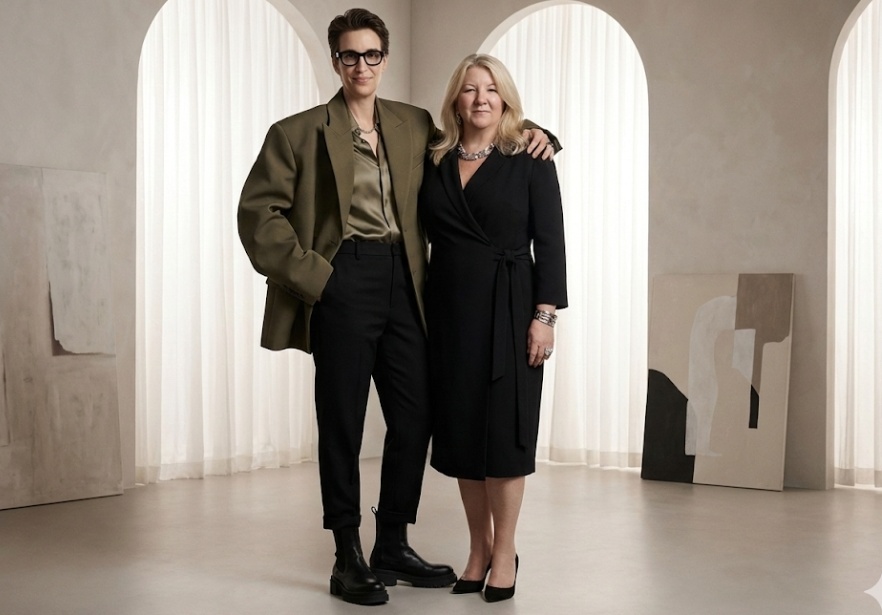
Interest in the age difference between Rachel Maddow and Susan Mikula has resurfaced online, not because of any controversy, but because their relationship continues to stand out in the public eye for its longevity and stability. In an era where celebrity relationships are often short-lived and heavily scrutinized, theirs has quietly endured for decades, prompting curiosity about how two people from different life stages built something lasting.
Rachel Maddow was born in 1973, while Susan Mikula was born in 1958. This places their age difference at approximately 15 years. On paper, that number may seem significant to some observers, especially when applied to public figures whose lives are routinely analyzed. In practice, however, the age gap has never appeared to define or limit their relationship, either personally or professionally.
The two met in the late 1990s under circumstances that were strikingly ordinary. Maddow, then a student, was hired to do yard work at Mikula’s home. At the time, Susan Mikula was already an established artist, known for her large-scale photography and unconventional approach to visual storytelling. Their connection grew gradually, rooted more in shared curiosity and conversation than in public image or career ambition.
What often gets overlooked in discussions about the Rachel Maddow Susan Mikula age difference is where each of them was emotionally and intellectually when they met. Maddow has frequently spoken about how Mikula’s life experience, independence, and creative outlook influenced her early adult years. Rather than a power imbalance, their relationship appears to have been shaped by mutual respect and complementary strengths.
As Maddow’s career in journalism accelerated, particularly with her rise at MSNBC, Mikula remained largely outside the television spotlight. This contrast has only fueled public curiosity. While Maddow became a nightly presence in millions of homes, Mikula continued to focus on her art, exhibitions, and photography projects. The difference in age also coincided with a difference in professional paths, which may have helped the relationship avoid some of the competitive pressures common among high-profile couples.
From a broader perspective, the public fixation on their age difference says more about cultural expectations than about the couple themselves. Age-gap relationships, especially involving women who are older than their partners, are still treated as anomalies in mainstream discourse. In that context, Maddow and Mikula’s partnership challenges traditional assumptions, particularly because the younger partner is the more publicly visible and financially prominent one.
Over the years, neither Maddow nor Mikula has made their age difference a talking point. They have addressed their relationship sparingly and on their own terms, often emphasizing normalcy over novelty. This refusal to frame their partnership around numbers may be one reason it has remained relatively free from scandal-driven media cycles.
What is clear, based on the timeline alone, is that their relationship has outlasted many same-age celebrity marriages. That longevity tends to shift the conversation away from how old they were when they met and toward how they’ve managed to stay together in the face of demanding careers and public attention.
Ultimately, the Rachel Maddow Susan Mikula age difference is factual, but it is not explanatory. It does not explain their compatibility, their resilience, or their shared life. If anything, their story illustrates how age becomes less relevant when values, independence, and mutual support align. For many observers, that may be the more interesting takeaway than the number itself.